
Invincible Summers
Camus, Dylan, and the Defiant Choice of Joy

It is rare that people come to the writing of Albert Camus or the songs of Bob Dylan looking for an injection of joy in their lives.
Because of this, when they do embrace joy, the impact is all the more intense — a full-flushed exuberance that bursts off the page.
To grasp the importance of this, in the context of this blog, requires an understanding of the root of the word “joy” and how it differs from “happiness.”
“Happiness” comes from Old English hap meaning chance or luck. It is similar to “happenstance” in this respect and implies that it is something that happens to you, as a result of external, circumstantial factors. In this sense, to be “happy” is to be favoured by fortune.
“Joy,” by contrast, is rooted in the Old French word joie and is more closely related to rejoicing or being delighted. The implication here is very different. Here the focus is on inner exultation, and critically for the absurdist position, on choice, not chance.
Happiness depends on what happens.
Joy is a choice that can be made, regardless of what is happening.
In this sense therefore, joy is one of the most authentic, defiant responses to an absurd, meaningless world, where circumstances are never “happy.”
It is important to remember however, that the absurdist equally does not see this lack of meaning as a cause for desperation or a reason to despair. Rather, it just is.
The absurd man (or artist) chooses to revolt in the face of this lack of meaning.
It’s one thing to imagine Sisyphus happy, but can we imagine him joyful?
That’s the ultimate test of the absurdist position.
So how does this choice of joy appear in Camus’s work — with its famously bleak titles like A Happy Death, Exile and the Kingdom, The Plague, and The Stranger?
The choice of joy is most beautifully and evocatively captured in his 1952 essay Return to Tipasa:
“In the midst of winter, I found there was, within me, an invincible summer. And that makes me happy. For it says that no matter how hard the world pushes against me, within me, there’s something stronger — something better, pushing right back.”
It’s interesting how Camus links the word “happy” to the realisation that what lies inside (“the invincible summer”) is stronger than what lies outside (“the midst of winter”). This adds a further dimension to the distinction between joy and happiness.
Put simply, you might say that Camus is “happy” at discovering the potential to choose “joy” that he necessarily and inevitably possesses as a human being.
He recognises that joy is an eternal choice that we have inside, but he is also quick to point to the fact that this realisation “makes me happy.” In contrast to the “invincible summer” itself, his response is at once personal (“me”) and transient (“happy”).
What is implied is that “happy” is his response, and his response today, on this occasion. A different person might choose a different response today and he himself might make a different choice tomorrow.
Return to Tipasa is a moving account of Camus’s return to Algeria after war, exile and personal loss. The devastation he encounters might have overwhelmed a different man, but for him, he also notices the beauty that remains — the sea, the sky and the warmth of the sun.
This is joy as defiant choice — a conscious embrace of beauty. He knows it cannot and will not last, but he knowingly chooses joy in the face of the apparent absurdity of that choice.
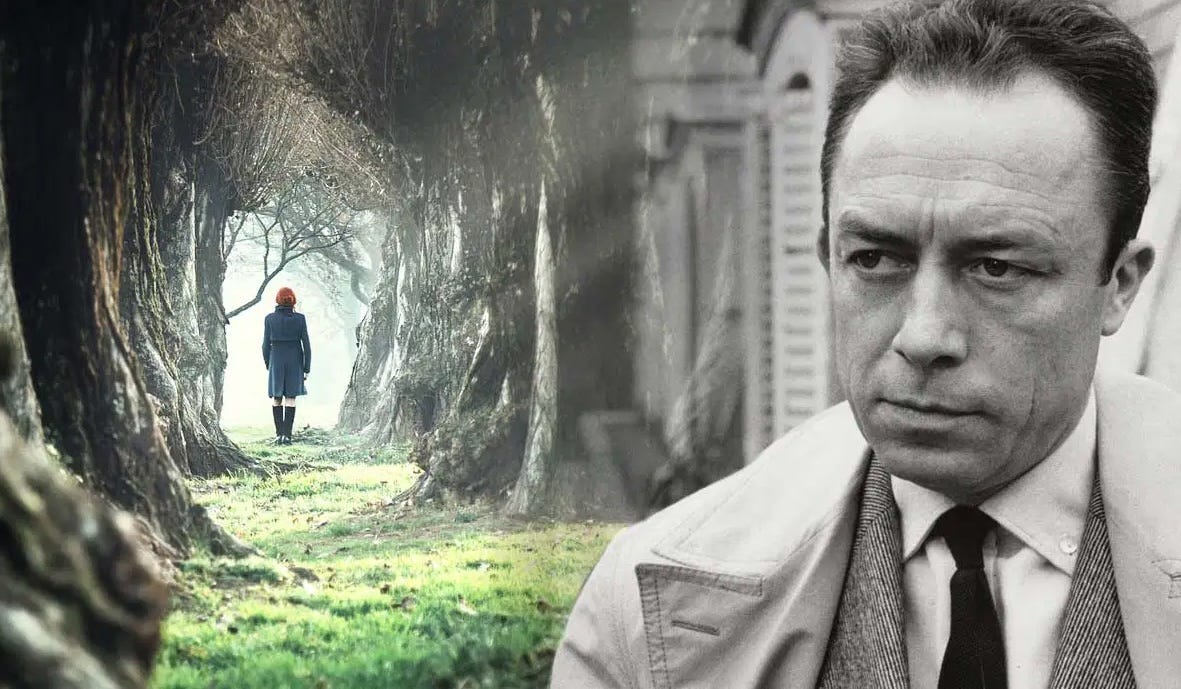
So, where does Bob Dylan embrace the choice of joy in the same way?
Where Camus is generally bracketed with existential despair and angst, so Bob is routinely linked to protest, seriousness and surreal, deep lyrics (or so my wife tells me).
Where is the joy in all that?
Similarly to Camus, the joy is fleetingly expressed, shafts of sunlight in a body of work that often focuses on the absurd elements of existence in a more unrelenting fashion.
The most powerful shafts of joy are found in Bob’s days away from the intense glare of superstardom that threatened to engulf him in the 1960’s.
I don’t believe that it’s an accident that Camus found his “invincible summer” in a similar place to where Dylan wrote songs such as New Morning, Sign on the Window, Forever Young and If Not for You.
Both men found joy by going home. For Camus, this meant a literal return to Algeria; for Dylan, a figurative return to family.
Both men also discover joy in the natural world — in the world that simply is.
The joy that exudes from New Morning is impossible to overlook.
In particular, these lines:
“This must be the day that all of my dreams come true /
So happy just to be alive, underneath that sky of blue.”
echo Camus’s words in Return to Tipasa:
“I again feel that I am right, that I was right to have chosen the clear waters and the gentle warmth, the naked sky and the stubborn trees.”
And from Sign on the Window, also from the New Morning album:
“Build me a cabin in Utah, marry me a wife,
Catch rainbow trout, have a bunch of kids who call me ‘Pa.’”
For both of them, the defiant choice of joy is rooted in simplicity: family and nature.
And, maybe most simply and beautifully of all, from Forever Young:
“May your heart always be joyful, may your song always be sung,
May you stay forever young.”
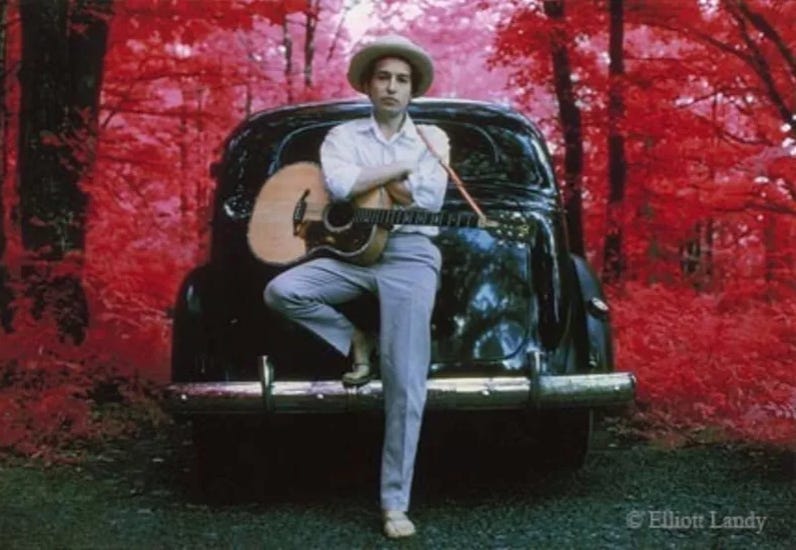
Finally, and not coincidentally, both men’s joyful expressions come after painful periods in their life. It’s almost as though the joy of choosing the “invincible summer” only emerges after experiencing the deepest parts of winter.
Joy doesn’t emerge from denying reality.
Joy is revolt in its purest form — a defiant yes to life as it is.
A truly defiant choice, made by the absurdist man.
Terrific insights!
Great post! Lots of emotion in Dylan, anger, resentment, astonishment, love, and joy. Mr. Tambourine Man is joyous. Love Minus Zero, No Limit, has, of course, love. Every Grain of Sand astonishment. (No need to detail the anger and resentment) One could go on, of course and I hope you will.